
Back in the Spring 2026 edition of Trail, we reviewed Graham Field’s book, ‘Second World Problems’ – very favourably I might add (read the review below). Now, this being October 2026, Field has a new book release, one he hints that may well be his last, too, although let’s wait and see on that account.
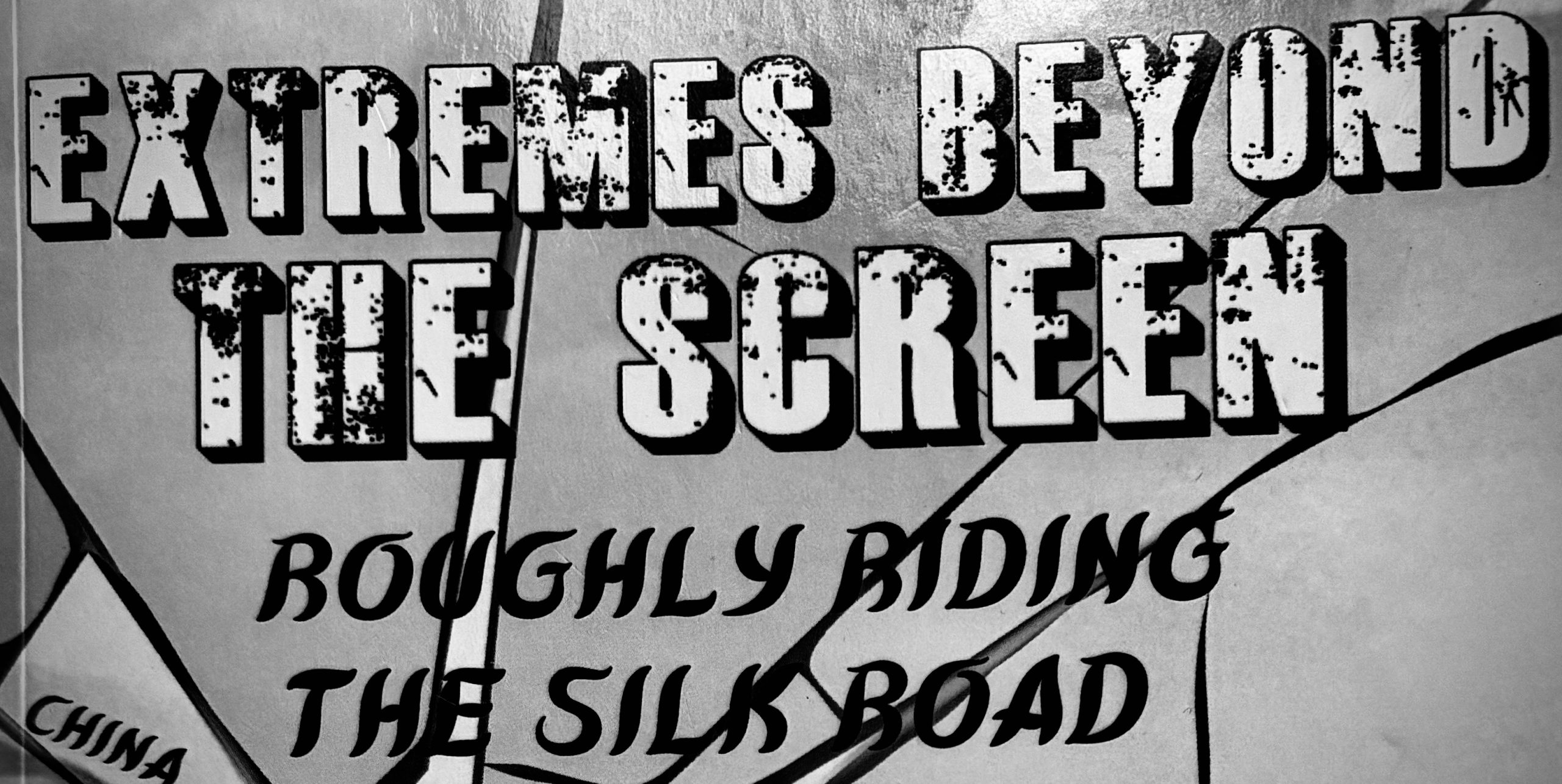
“Extremes beyond the screen” is Field’s story of his recent motorcycle trip into the ‘stans, starting from his home in Bulgaria, leading to Tajikistan as his furthest point east. Anyone who will have read “In search of greener grass” will immediately note this is nowhere near as far as he reached in that journey some 16 years ago – Vladivostok and ultimately South Korea. This book’s journey was no 100-day continent-spanning odyssey, in fact the core narrative covers around a month on the road.
And therein lies the story. With echoes – on a smaller scale – of Ted Simon’s “Dreaming of Jupiter”, this is kind of a journey repeated, years later, with all the changes in the world encroaching, as they do. Okay, Simon was 70 in his book, Field 60 in this, but the theme is very similar, aging man fighting – almost hopelessly – against the tide of change.
Field and his bike, a 25-year-old Kawasaki KLR650, originate from a different, analogue era in travel motorcycling, their youth long passed, their relevance today possibly diminishing. But they rage, not against the machine, but the virtual. The internet, digital mapping and navigation, the mobile phone and the development of software – apps – for everything it seems, all these have taken over travel motorcycling as much as they have everything else in the world. For some this is a liberation, for Field – and many others – it’s a terrible loss, removing the sense of exploration and diminishing the effort, the excitement and the enjoyment of travelling into the unknown. Trying to distance himself from this new age, eschewing digital aids for paper maps and hard-won travel nous, Field is only partially, fleetingly, successful in recreating the joyful travel ethics and emotions of his past. Which is why this book doesn’t recount 100 days on the road; there is a point, as there was for Field, when you just have to concede defeat.
So you could call the book one long moan. And yes, it kind of is, but fortunately Field thinks and writes intelligently – and entertainingly – enough as to engage our own sense of circumspection. As we’ve come to learn, all too painfully, and for some tragically, not all the latest technological advances are making the world a better or safer place.
We can be critical of Field if we so wish, for he is in this book travelling the Pamir Highway, part of the ancient Silk Road, only this is 2026 and the push to ever more road building and the homogenisation of urban living – again taking the lead from the worldwide influence of the internet – has made the once-far flung far less exotic than it used to be. Is there a clue, too, in the name? Highway – it’s a main artery. Is this like looking for curiosities on the M1? Then there’s the popularisation of adventure travel, with package tour groups, YouTubers and others that today crowd the common bucket list routes and destinations – this we have seen for many years now. None of this is Field’s fault, but crunching serious daily distances, seeking to distance himself from these realities, as Field did, can’t help either, and when done in desperation, even more so.
Field still has his summit moments, at least a couple of them, as ever neatly, engagingly recounted, but the euphoria clearly doesn’t last (it never does!), and while, sure, there’s no place like home, to which Field retreats, we still need to travel. And Field plans for more of that, with family, with 90-year-old mum (good on him) – only not for this or any book.
So, just as in life where there’s rarely a happy ever after, Field leaves us at what seems to be his own metaphorical motorcycling crossroad. It’s one many of us arrive at late in our motorcycling lives, where we ask quite simply, and with surprisingly less comprehension than we thought our advanced age would bestow, ‘what next?’
Buy the book at: www.grahamfield.co.uk £18.99
By Graham Field
£15.99
I’m not a fan of motorcycle travel writing, least not in the long form. And I’ve said it before, even coached contributors on this point – I particularly don’t favour day-by-day recounts of motorcycle trips. And long hair on men, I’m not into that either. Nor heavy metal / rock.
So, given all that, I’m here writing a review in praise of Graham Field and his nine travel books mostly involving motorcycling (more or less). Field has long hair, has been a lifelong fan of Motörhead (Pink Floyd, too – I’ll make a concession on ‘Floyd at least) and writes his travel accounts as day-by-day travelogues. So this surely cannot be ‘my bag’?
Only here’s the thing. Field’s books differ in so much as he can write. Not like a literary giant, but more importantly in an engaging, witty and typically self-deprecating manner that keeps you turning the pages. I suspect his craft has developed from writing a daily diary. Field has done so for most of his adult life, not just when on his travels. And so he practices his writing daily and therefore has an instinct for creative penmanship. I mention this as not all world travellers should be authors, one doesn’t automatically begat the other.
But even more importantly, he writes truth. His truth I dare say, not everyone’s, but he’s honest to who he is and his opinions. His first book, ‘In search of greener grass’ is a diary of his 100-day (ish) ride from Essex to Vladivostok (and onto Korea) on a £750 Kawasaki KLR650, on a budget of £50 a day. This was back in 2010. What’s to like with this book is his commentary of what it feels like to be on such a trip. Some writers fall into the trap of trying to describe all they see, as if the world is an unknown to rest of us (it’s not…) but Field instead reveals the emotions of such a ride, typically triggered by his social interactions. He doesn’t seek to aggrandise his journey, nor does shy from the naked truth that the world’s cross-continent arteries are near-clogged with RTW travellers – and all that comes with that.
Field’s latest book, ‘Second World Problems’, is, would you believe, the third part of the continuing story of his relocation to Bulgaria. Even with precious little motorcycling – it’s more about his home building, life after the big trip if you like – the reading is vivid. And that’s right from the opening pages when he describes his stay in a Bulgarian hospital while suffering from a kidney stone flare up. His account of drifting in and out of consciousness, as the nurses come and go to alter his sedation, is spot on, almost hints of ‘Comfortably numb’ by ‘Floyd. This being his ninth book it reads more polished than his first, by now being a practiced art.
But Field’s aware that these books – his books – might very well be a dying, maybe irrelevant media. “I’m old school,” he writes, “I like to escape into a book, not to be confronted by a video, engage with a stream, connect to a live feed. I don’t subscribe to that style of travel. However, the short attention span, instant gratification generation are coming of age and getting out there, and aren’t we supposed to be encouraging this? Obviously, they have their own style. Written words are past content, the future will be shot and edited into shorts…”
It’s true, video is the dominant media today, the influencer cum travel rider currently holds sway with the public, even the industry. But the written word, when articulated well, still has value, still strikes deeper, connects more meaningfully. And Graham Field deserves credit for his considerable contribution. Bloody hippie.
Trail Riders Fellowship
Registered in England and
Wales No. 05848933
218 Strand London WC2R 1AT